|
|
|
|
 |
|
|
featured artists
Diego Rivera

|
biography
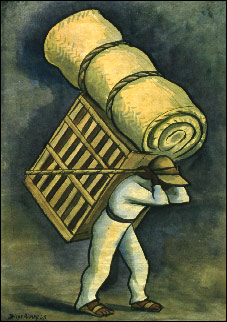
(b. Guanajuato, Mexico, 1886; d. Mexico City, 1957). José Diego María Rivera was part of the "Los Tres Grandes" (The Three Great Ones) of the Mexican Muralist movement together with José Clemente Orozco and David Alfaro Siqueiros. When he was a child his family moved to Mexico City where Rivera studied at the San Carlos Academy under Felix Parra, Jose Maria Velasco and Santiago Rubell. Awarded a grant by the government in 1906, he traveled to Spain where he studied with Eduardo Chicarro y Aguera and later to Paris where he met Picasso and other avant-garde painters. During this period he painted works closely related to Cézanne and Cubism. In Paris he discussed with Siqueiros the revolutionary art politics that would later form the basis of the Mexican Muralist movement. In 1920 he visited Italy and was inspired by the murals of the great masters of the Renaissance. Back in Mexico and sponsored by José Vasconcelos, the Secretary of Education, Rivera began his first mural Creation at the National Preparatory School, 1922. It is during this time that Rivera consolidates a socialist iconography combining pre-Columbian art, Folk culture, Cubism, Renaissance frescoes and Maya mural paintings. Imbued in socialist ideals Rivera exalted the working class and Mexico´s history. He also co-founded the Union of Technical Workers, Painters and Sculptors, and its organ, the journal "El Machete." In 1929 he married the painter Frida Kahlo. As a member of the Communist Party Rivera's Social Realist style promoted the use of a great format for the creation of didactic works for public spaces. Although his Communist ideas placed him in deep opposition to U.S politics, he was nevertheless commissioned to paint several murals in San Francisco, New York and Detroit between 1930-1934. Amongst them, he created his controversial mural Man at the Crossroads at the RCA building at the Rockefeller Center. This mural was later destroyed because Rivera refused to eliminate the portrait of Lenin. Rivera played a pivotal role in the consolidation of a strong international image for the Mexican Muralist movement and was the second artist, after Matisse, who was honored with an individual retrospective exhibition at the Museum of Modern Art in New York. Although he is most well known for his murals, Rivera also painted several portraits and landscapes. Death form heart failure in 1957, accorded him official honours, Palacio de Bellas Artes and buried in the Rotunda of Illustrious Men, Mexico City. His art collection willed to the Mexican government.
|
back to artists
|
 |
|