|
|
|
|
 |
|
|
featured artists
José Guadalupe Posada

|
biography
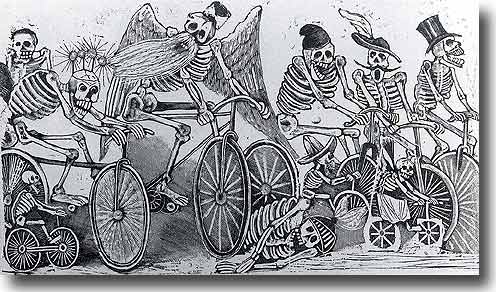
(b. Aguascalientes, Mexico, 1851; d. Mexico City, 1913). This Mexican printmaker and draughtsman showed an aptitude for drawing as a child and briefly attended the Academia de Aguascalientes, where he was taught by Antonio Varela. Afterwards held a lithography apprenticeship in the workshop of Jose Trinidad Pedroza and began to attract attention with his critical illustrations for Pedroza's periodical El Jicote. Local political pressures forced both men to move in 1872 to Leon, Guanajuato, where Posada began wood-engraving. In 1884 he taught lithography at a local secondary school. Following the severe floods of 1888 he moved to Mexico City, where the following year he began to work as a draughtsman and engraver at Antonio Vanegas Arroyo's printing house, which he remained affiliated with until is death, and started to move away from lithography towards cheaper printmaking on zinc, wood and type metal for which he used for the greater part of his prolific output of 20,000 engravings. Posada and Vanegas propagated news items on printed flyers, illustrated by Posada as corridos gráficos in order to communicate with a largely illiterate public. He drew scenes from daily life, such as festivities, brawls and traditional customs, as well as popular character types and portraits of such heroes as Emiliano Zapata and depictions of dramatic religious scenes. Posada also contributed to many periodicals, including La Patria Ilustrada, El Centavo perdido, El Teatro, Vanegas's La Gaceta callejera (e.g. Great Pantheon of Lovers, El San Lunes and El Hijo del Ahuizote. The political and social stance of these periodicals, however, led to repeated brief periods of imprisonment of both men. Posada's fictional character Don Chepito was one means to convey social criticism, but he is perhaps best known for his costumed skeleton characters or calaveras. He used these as a vehicle for political and social satire in which he criticized the living in terms of the dead and what he saw as an obsession with progress.
|
back to artists
|
 |
|