|
|
|
|
 |
|
|
featured artists
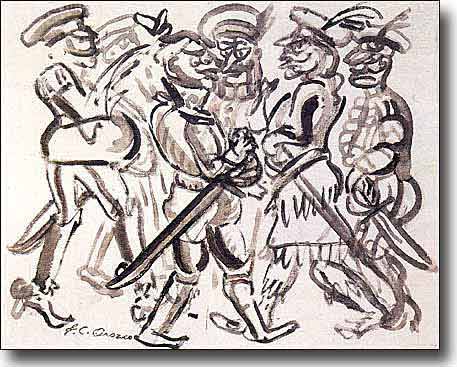
José Clemente Orozco

|
biography
(b. Cuidad Guzman, Mexico, 1883; d. Mexico City, 1949). Orozco is recognized as one of the most significant Mexican artists and best known for his instrumental role in the Mexican Mural movement. Orozco was born in 1883 in Cuidad Guzman. But moved to Mexico City with his family at a young age. There he gained an interest in the arts and was allowed to observe in the engraving workshop of the well know José Guadalupe Posada. While in high school he took classes in art and then later devoted himself to studying art full time after an accident left him without the use of his left hand and with significant hearing loss and damage to one eye. He studied at San Carlo Academy where Dr. Atl was the director and pushed the school in a more modern and liberal direction. When Dr. Atl was dismissed from his directorial position because of a students' strike. Orozco joined his "Centro Artistico" group. Orozco began working as a cartoonist during the Mexican Revolution for a revolutionary army. He later continued his work as a cartoonist for the anti-Madero newspapers El Imparcial and El Hiio del Ahuizote. Orozco worked on his first mural project at the National Preparatory School where he painted scenes from the Mexican Revolutionary war with Diego Rivera and David Alfaro Siqueiros. These three mural painters, known as Los Tres Grandes, became the three key figures in the Mexican Mural Movement. While Orozco's work was as socially minded as that of Rivera and Siqueiros, he remanded relatively neutral when it came to political alignment. In 1930 Orozco traveled to the U.S where he was commissioned to paint mural at the New School for Social Research in New York, and at Clairmont College in California. He traveled to Europe for the first time in 1932 where he visited museums and monuments. He was most inspired by fresco painting particularly the Sistine Chapel. Orozco returned to Mexico, to paint his most famous mural, Catharsi, at the Palacio de Bellas Artes. He worked on other murals including series in the Guadalajara Chamber of Deputies, the Hospicio Cabañas and at the University and Government Palace. In 1946 he received an award for his work on the murals at the Church of the Hospital of Jesus and the Palacio de Bellas Artes in Mexico City held a retrospective of his work.
|
back to artists
|
 |
|