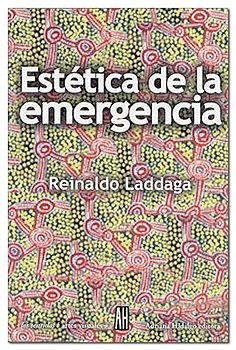
Interview with Reinaldo Laddaga on Art of Emergency.
The formation of another culture in the arts. Part One. The hypothesis that Reinaldo Laddaga suggests in "Estética de la emergencia," a book recently published in Buenos Aires by Adriana Hidalgo, is ambitious and crucial. In his view, we are in the presence of a new "regime of the arts" --the concept belongs to Jacques Ranciere-- that would, on the one hand, bring to a close the aesthetic age of art --a period extending from the end of the XVIIIth C. to the decades of the 60s and 70s in the last century-- and, on the other hand, open a new era about which we know little but would involve fundamentally new forms of production, conceptualization and visibility. A whole constellation of the arts, Laddaga points out, is taking shape while intersecting with modes of eminently immaterial and communicative production, taking place in the sphere of labor, in political practice, the sciences and in the ways that people and information circulate within a highly fluid globalized economy that is post-national and post-state oriented. The concrete cases providing a foundation to the hypothesis of a new regime in the arts --that Laddaga will call practical, and which in this interview he will, at the same, question-- are: Peter Watkins' La Commune, Paris 1871; Christoph Schäfer's Park Fiction; Roberto Jacoby's Proyecto Venus; Lisa Robert's What's the Time in Vyborg; the Wu Ming group's La Ballata di Corazza; and Warren Sack and Sawad Brooks' Translation Map. Of course, in this case personal names do not refer so much to an author as to the person who designs the initial architecture of a project and puts it forward to a community in the making with which s/he finds a sphere of common and coherent interests. Each of these projects brings into existence a sphere of collective input that is sizable both in time and in the number of participants required; a space that is neither strictly private nor totally public, in quite the same fashion as our modern concept of the public domain implied a universal and undifferentiated receiver. On the other hand, it is possible that these projects will involve the production of a work of art, except that what is going to be involved is an entity that has been left open. To a certain extent controlled by its "proponent" but to a certain point not so controlled: the object will acquire relevance thanks to what each individual or group brings to it pending each person's possibilities for collaboration. Above all, this will be the medium through which those implicated will find it possible to shape themselves into an autonomous community of some sort. All of which follows a new idea of the public domain, implying at once a necessary closeness, a propensity for long-distance communication and unexpected encounters: which is what new technological networks and the very fluidity of contemporary subjectivity are bound to facilitate. What is involved is a set of post-disciplinary tactics that include artists equally as much as non-artists, whose evolution runs parallel to the weakening of the disciplinary regime theorized by Foucault and which involves, among other things, the deconstruction of that characteristically modern way of grouping art around a sphere of production, and perfectly separating it from everything else. One of the questions one asks while reading Estética de la emergencia deals with how art might contribute to the shaping of new political trends. If community today is not something that is established a priori, but is in constant need of assembling, we might say that an act of creation would be involved whenever a community is brought into being. Nonetheless, nothing prevents these communities from establishing simple mechanisms for exercising control that, at the micro level, reproduce global marketing strategies for modulating or controlling subjectivity. In this sense, some of the cases that Laddaga observes might be defined as communities of resistance, and others, as forms of exchange that in no way can be set apart from the vast inventiveness of the marketplace. It is not, hence, a militant reading that the philosopher advances but rather a theorizing on new kinds of associations from the point of view of its morphology. The following interview intends to follow these new and complex aesthetic social structures to some extent, taking as a point of departure a fundamental question: the question as to what, in a post-Marxist world, the left would be inclined to support.
|