|
Cheryl Hartup, associate curator of the Miami Art Museum, emphasized the vision of Eugenio López, possibly the most important art patron of the present time, in these words: "The passion allowing him to provide support to the projects of young and unknown artists, when nobody will, provides them with resources, and the way in which his confidence in the future of these artists spurs him to run risks, is a guideline for curators". López possesses a global collection of contemporary art and has encouraged Mexican artists in an international context. Thanks to him, we have seen facilities or projects acquired by private collectors which institutions are unable or afraid to purchase. The Twelve Trees of Christmas by Paul McCarthy, for example. "Doubtless," Hartup maintained "the videos of icons in strange situations, or the installations he promotes, not only have an impact on visitors, but influence young artists". He promotes challenging works, while at the same time itís already known in the art market that pieces chosen by Eugenio López are going to have a broad impact. A well-known fact is that López acquired the work Diamond Sea, by Doogaitken, from a small gallery in New York, and that it subsequently caused a sensation at the Venice Art Fair.
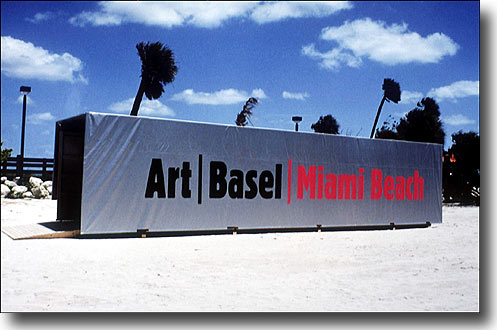
Art Basel was also a window on the questions currently arising on the art scene: the debate on the death of painting –"We are only interested in painters who work around this idea", said Paco Barragán, curator of the Deluxe Miami exhibition, "the displacement of the famous artist for the idea of communal creations; and, naturally, for the basic themes of contemporary art. Outstanding among these are three key aspects, due to their reiterative nature: migrations, variations as regards the object, the use of power, exploration of the disintegration both of the body and of the individual, and of group cultures."
With reference to the subject of migrations from the third to the first world, a critical representation taken from the levels of significance and alternate perspectives prevailed: from the imaginary level of the desire – for consumption – put forward as the spur for the migratory travel of human undercurrents, to the conversion operating in the receiving countries (Spain or the United States) on transforming the immigrants from "desiring individuals into object-works" useful for the productive cycle. While people are changed into an interlocking mechanism, consumption becomes a structural axis, almost the principal subject.
Various videos of different artists resorted to the idea of a box inside which the illegal immigrant travelled. An image related to the strategies of camouflage and survival which he has to develop. In the case of the work presented by Pablo España, the accompanying catalogue includes textual quotes from immigrants in Spain and statistics which create an emotional charge around the subject. The Colombian, Carlos Blanco inserted a family of illegal immigrants in a gigantic plastic bottle, symbol not only of launching oneself into the unknown, but also referring to the windows from which they will view the world when they disembark: they will recreate the view in contemplating objects even though they cannot buy them. The Mexican group Torolab dealt with the matter with a bit of black humor on presenting their trans-migratory SOS trousers with a survival unit and a facility reflecting an imaginary city like Tijuana, where going to, and coming from, the border is the center of life. There was a clear presence of proposals developed around migration and increasingly-compressed living spaces: portable beds, inflatable objects to carry in a bag. In all the cases these artistic projects are recording the experience of city or town dwellers who cross boundaries with the hope of participating in the first world - experiences that often involve bodily experiences.
|