|
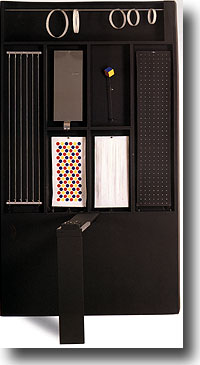
Siete movimientos sorpresa (1966), by the Argentine Julio Le Parc (b. 1928) for his part, represents a paradigmatic example of Cinetic art. In 1958, Le Parc moved to Paris where, two years later, he formed the G.R.A.V. (Groupe de Recherche d'Art Visuel), bringing together artists of different origins. After engaging in bi-dimensional work generally in white and black, La Parc began during the sixties to work on more complex art forms, covering the third dimension. Siete movimientos sorpresa belongs to this period, in which the spectator was invited to participate by putting various surprising mechanisms into action.
For conservation reasons, the works of Clark and Le Parc which originally called for the intervention of the public to complete their meaning, can now only be manipulated by authorized museum personnel, thus ensuring their preservation.
On outstanding space inside the MALBA is occupied by the work Rompecabezas (1968/70), by the Argentine Jorge de la Vega (1930-1971). Seventeen of the thirty panels which originally made up this work, where the ludicrous is considered as another component since it allows for different orders and formats, are presented in the central hall of the museum.
Perhaps the Argentine artist with most international prestige at the present time is Guillermo Kuitca (b. 1961). Siete últimas canciones (1986) belongs to the series of the same name, in which the artist presents large spaces, almost theatrical, practically uninhabited, where the main theme appears to be solitude and isolation. Outside his country however, Kuitca is better known for his handling of apartments, mattresses and maps. Siete últimas canciones signified finally for the artist the end of many things; on the one hand the conclusion of a series; on another, the last showing which he artist would carry out in Buenos Aires. From then on, Kuitca only exhibited outside the country. Perhaps the opening of the MALBA will change this situation in the near future.
|