|
As from 1936, Berni would refer to this series of works - in which he found his own vocabulary halfway between the mural and trestle painting - defining them as New Realism. In this way, it is possible that he marked the correspondence between his ideas and those which a group of painters had begun to develop in Germany over ten years before, and which we know today under the name of Neue Sachlichkeit (New Objectivity).
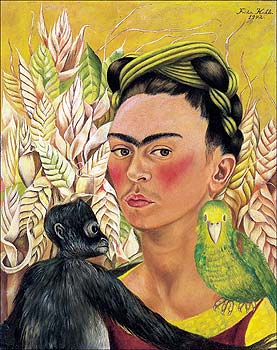
Also among the works of the Costantini Collection is Self-portrait with monkey and parrot (1942) a work by the famous Mexican painter Frida Kahlo (1907-1954) who was, to a certain extent linked to the Surrealism program. According to E.F. Calvo, "the monkey, as all simians, has a familiarity with the human being but, being an animal, eventually presupposes an incapacity to control its powers and its instincts. The same can be said of the parrot, which is capable of repeating words but not of understanding their meaning. However, by portraying herself with these animals, Frida has wished to tell us that she had achieved control or maturity over irrational things. For this reason her hair (....). has been submitted to vigorous brushing." Perhaps this same nature can be attributed to the ears of ripe corn which appear in minutely descriptive detail in the background of the work. The key for interpretation put forward by Calvo is based fundamentally on happenings in the personal life of the artist. Between 1939 and 1940, Frida had separated from Diego Rivera and in an attempt to earn her own living, had begun to produce a large quantity of work in comparison with previous periods. For this reason, when she again married the muralist in December 1940, Kahlo had already achieved widespread recognition as an artist. In the first half of the decade, which began at that time, self-portraits began to be more common among her works, in which the painter appears accompanied by her domestic animals. Self-portrait with monkey and parrot is an unusual painting in the artist's career, due to the strangeness of her clothes and the hairstyle with which she is represented, since it is usually fairly simple to identify their origin. However, it is also a work representative of her production during the forties, with abundant self-portraits which,, as in the present case, she her with certain other elements describing traces of her personality or her mood.
Two other works belong to these same years, one by the Chilean Roberto Matta (b.1911); the other, by the Cuban Wildredo Lam (192-1982). During the decade of the thirties Matta and Lam had taken an active part in the surrealist movement. Los desastres del misticismo (1942), a work by the Chilean artist, belongs to a period in which the painter - who had been an important influence for the painters of the New York School - began to take an interest in magic, the tarot and the cabala. This trend is evidenced in the title given to this work, governed by an atmosphere of organic metamorphosis. La mañana verde (1943), by Wilfredo Lam, belongs to the period evidenced by his attempt to recover the beliefs and exoticism of Cuban society. Since his return to Cuba (1941), Lam would attempt to synthesize the contributions of Cubism and Surrealism and, to give account of the mythical and erotic universe of Afro-Cuban religion, would present hybrid figures (zoo and phytomorphic) and ritual objects or attributes incorporated into the landscape. A bird-hybrid appears in La mañana verde. The bird is one of the habitual figures of his work and, generally, "is shown anatomically joined to other personages due to its relationship with the orisha Eiye ororo (which can be translated as "bird in the head". For the Yorubas this is the bird which God places in a man's head on birth as an emblem of the mind).
Between the 1950 and 1960 decades, Latin American artists began to radically modify their artistic practices, interested by the application of new technologies to a different art - generally abstract, constructive and participative - impregnated by a new international spirit. In accordance with the ideas proposed by the traditional avant-garde (prior to the Second World War), and recovering the romantic principle of "education for art", Latin American artists turned themselves over to a type of production which endeavored to link art and life, the rational and the instinctive. And if the purpose was to generate a universal art, geometry could provide a language of synthesis, equally available to all. On the borderline between rationalism of the geometric order and a search for the subjective participation of the spectator, proposals were made such as that of the Neoconcrete Movement in Brazil and that of Cinetic art, practiced by artists of different nationalities.
Bicho (1960) by the Brazilian Lygia Clark (1920-1988 belongs to the first of these movements). The Neoconcrete artists thought of the work of art as "a being whose reality is not exhausted in the outside relations of its elements; a being which can be broken down in parts by analysis, accessible only to thought in the direct, phenomenological approach" (Manifiesto Neoconcreo, Río de Janeiro, 1959). The Bichos series, carried out by Clark as from the sixties decade fully coincides with this definition: it deals with objects which are organic in appearance (hence its name), constructed from aluminum sheets joined together by hinges which, when it is manipulated, allow it to change form.
|