|
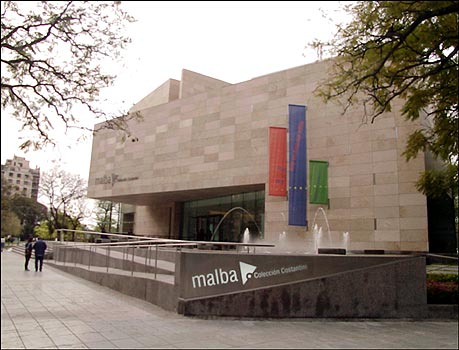
Included in the works of the Collection are unavoidable examples from the history of Latin American art. This is the case of Abaporu (1928), by the Brazilian artist Tarsila do Amaral (1886-1973). In the Tupi-Guarani language, Abaporu signifies "man eating". This work was linked to the beginnings of the modernist movement Cannibal, promoted by the poet Oswald de Andrade, husband of Tarsila and original recipient of the painting. The claims of the cannibalistic manifest, presented in a "poetic metaphoric and humoristic" language, were in fact of a philosophic nature and endeavored in part, to recover the primitive element in civilized man - a goal common to many of the vanguards originating in the first part of the XX century. Taking as a base an aboriginal belief that by devouring one's enemy, one assimilated his virtues Oswald de Andrade proposed the swallowing of European cultures and techniques in order to re-issue them in indigenous form. In this way an artistic renovation would be achieved, linking in one native trends and internationalism. Oswald had detected this attitude in the Abaporu of Tarsila a work of synthesis between the influence of the European vanguards (above all through the Frenchman Fernánd Leger) and the elements of a personal landscape inhabited by a single being of monumental dimensions. Already toward the end of the twenties decade, the artist showed an interest in what was to become one of the principal concerns in the Brazilian art of the thirties: the recovery of national roots. During that period, for his part, the Uruguayan Joaquín Torres-García (1874-1949) began to establish the bases of a constructive universalism. Despite having been born in Montevideo, Torres-García spend the greater part of his life in Europe - except for a period in New York between 1920 and 1922 - where he had moved with his family in 1891. Around 1917, and after executing a series of works, which the critics associated with "Noucentisme," he began to search for a synthesis between the proposals of Cubism and those of Futurism. His art became simpler: he began to divide the surface areas, combining images possessing different special realities in a single work. There the dynamic sensation of Futurism began to present itself under a plastic arrangement - increasingly strict - of Cubist origin. In 1918, he exhibited a series of wooden toys showing the influence of Balla at the Dalmau gallery, in which this taste for simplicity and order was once again demonstrated. The toys consisted - like the objects of the futurist - in a series of simple pieces which could be disassembled and which, through different combinations, could become more complex or acquire different positions. That same year, Torres-García had declared that being an artist signified "to feel the universal, reach foe the pure unembellished form of all accessory and contingent things". When, at the end of the twenties, being in Paris, he came into contact with Georges Vantorgerloo, Theo Van Doesburg y Piet Mondrian, he was to find the unembellished language he was looking for but which was still absent from his work. In 1930, together with the Belgian critic Michel Seuphor, he was to found Cercle et Carré, a grouping of constructive artists whose members included (among others) Le Corbusier, Arp, Russolo, and the same Mondrian and Vantongerloo. For Torres-García the construction must be, above all, the creation of an order from which a universal art would invariably emerge, capable of combining pure forms (the structure) and intuition. Composición Simétrica Universal en Blanco y Negro (1931) represented the result of his previous investigations and is, in turn, part of this search for universality. Taking advantage of the principles of the golden proportion an orthogonal reticule divides the surface into cells occupied by highly stylized figures (buildings, men, women, ships, animals, and anchors). In works such as this, the Uruguayan artist managed to combine the contributions of Cubism and Neo-plasticism, his art becoming a universal construction which, in placing the world in order, found its own order. In 1934, Torres-García would return permanently to Montevideo, where he was to have a fundamental influence on the future of avant-garde Latin American art. Manifestación (1934), by the Argentine Antonio Berni (1905-1981), another of the outstanding works of the collection, also belongs to the thirties decade. Berni had been in Paris between 1926 and 1929 where - influenced by the principal plastic works of De Chirico and by the ideas of Louis Aragón's circle - he carried out a series of works close to the principles of Surrealism and Metaphysical Painting. He returned to Argentina in 1930 where, three years later, he was to come into contact with the Mexican muralist David Alfaro Siqueiros. In conjunction with the Argentines Spilimbergo, Lázaro y Castagnino - all clearly influenced by the work and ideas of the Mexican - Berni and Siqueiros painted a mural and issued a manifesto, both entitled Ejercicio Plástico. These represented effective examples of what should be understood by a social projection art which in turn, made use of new techniques and new materials. The year 1934, however, represented for Berni a certain distancing from the ascent of Siqueiros. That which a year later was to culminate in an apology for trestle painting (Nueva Revista, 1935), had begun with the choice of an unusual support for his works: sackcloth. It is with this material, to which he applies industrial pigments, that he carries out works of heroic proportions for his period (180 x 249,5 y 200 x 300 cm.) where the form of existence and inconveniences of the Argentine working class are portrayed. One of the best examples of this new painting is the work which is housed today in the MALBA: Manifestación shows in the very near foreground (close up) a group of working calling for "bread and work". The faces of these men and women were taken from a series of photographs taken in the suburbs of Rosario (at that time one of the country's principal industrial centers). Behind the tumult, which covers almost the entire surface area of the picture a series of buildings is shown, where one can still perceive the powerful impression left in the Argentine artist by Metaphysical painting.
|